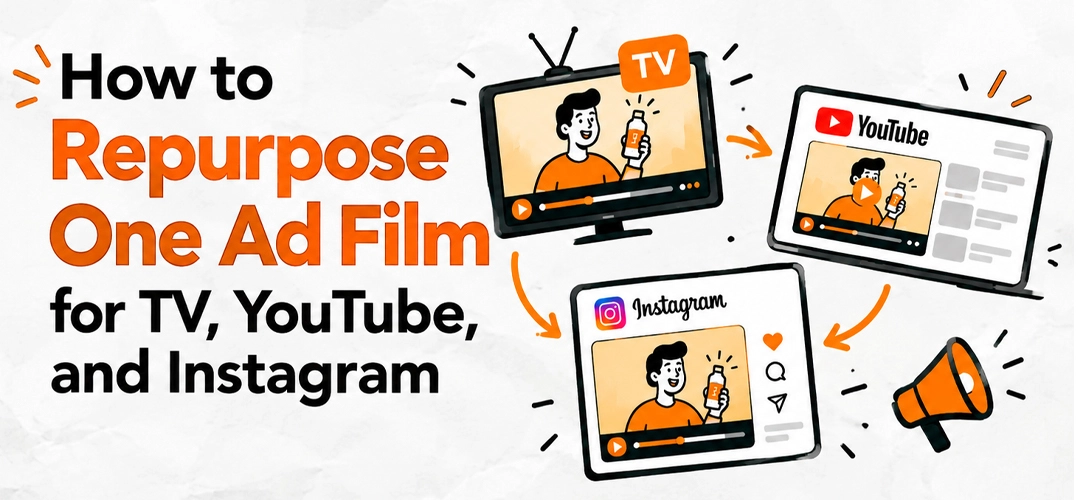
How to Repurpose One Ad Film for TV, YouTube, and Instagram
You’ve spent weeks developing the idea. The script is locked. The cast is ready. The shoot is done. The edit is looking great. Now comes the slightly uncomfortable question:
What happens after the TV commercial is ready?
If the answer is “We’ll put the same film on YouTube and Instagram,” you may be leaving a lot on the table.
A good ad film doesn’t have to live on just one screen. In fact, one strong film can become the starting point for an entire video advertising campaign if you plan for different platforms from the beginning. TV, YouTube, and Instagram may all carry video, but people don’t watch them in quite the same way. The screen is different. The attention span is different. The viewing environment is different. Even the reason for watching is different.
That means the idea can stay the same, while the execution changes.
Here’s how to make one ad film work harder without making it feel like the same ad copied three times.
What Does Ad Film Repurposing Mean?
Simply put, ad film repurposing means taking one core film and adapting it for different platforms.
The key word is adapting, not copying.
A 30-second TV commercial can become a shorter, faster Instagram edit, a slightly longer YouTube version, or a six-second digital cutdown. The idea stays the same. The format changes based on where people are watching.
| Platform | What the audience expects |
|---|---|
| TV | A complete, polished brand story |
| YouTube | Storytelling with room to explore |
| Quick, engaging, scroll-stopping content | |
| Performance Platforms | Clear message and quick action |
Start with one big idea, not three separate films.
The easiest way to make your production budget work harder is to stop thinking in terms of three platforms and start thinking in terms of one strong brand idea with multiple expressions.
Your TV commercial may carry the full story. YouTube can give the same story more room to breathe. Instagram can take the strongest moment, character, product benefit or line and turn it into a quick piece of content.
The core remains consistent:
Same brand. Same campaign thought. Different treatment.
This is where good brand video production makes a difference. The film should be created with enough flexibility to generate multiple useful assets later. So while planning the hero film, think beyond the hero film.
What else can you get from the shoot?
- A 30-second master film.
- A 15-second cutdown.
- Six-second bumpers.
- Vertical edits.
- Product close-ups.
- Character moments.
- Behind-the-scenes footage.
- Reaction shots.
- Still frames.
- Short clips for social.
Suddenly, one shot has a much longer life.
1. Start with One Big Idea, Not Three Separate Films
The easiest way to make one ad film work harder is to stop thinking about TV, YouTube, and Instagram as three completely different assignments. Start with one strong idea and build different versions of it for the way people consume content on each platform.
Your TV commercial might tell the complete story. YouTube can give that story a little more room. Instagram can pick up the funniest moment, strongest visual, or sharpest product benefit and turn it into something people can consume in a few seconds. The campaign stays recognizable across platforms, but the experience doesn’t have to be identical. Same big idea. Different ways to experience it.
And that thinking needs to happen before the shoot, not after the master film is locked.
2. Let TV Tell the Full Story
Television gives an ad film something precious: time.
You can establish a situation, introduce your characters, build the tension, bring the product into the story and land the brand message without rushing through every beat. That makes the TV commercial the natural hero of the campaign. But the hero film shouldn’t be treated as the only thing you’re producing. During the creative and production stage, consider which parts of that story could live beyond the television screen.
A 30-second TVC could later become a 15-second cutdown, a six-second bumper, a product-led edit or a social-first version. The TVC tells the story. The rest of the campaign finds new ways to keep it going.
3. Give YouTube More Room to Play
YouTube gives your ad film a little more breathing space. Someone may discover the brand while watching related content, actively search for something or simply decide to watch because the opening caught their attention. That gives you room to take the TVC further. You could create an extended version, a behind-the-scenes film, a product-focused edit or even separate videos around different audience needs.
For example, the TVC could create awareness while a longer YouTube film explains the product in greater detail. Another version could answer a common consumer question. Another could simply give people more of the story they already enjoyed.
That’s where digital video marketing becomes more interesting. You’re not just putting your TV commercial online. You’re giving the idea another place to work.
4. Make Instagram the Stop-Scrolling Version
Instagram doesn’t give you much time to make your point. There’s always another Reel waiting just one swipe away. So instead of dropping the entire TVC into a vertical frame and hoping people watch till the end, look for the moments within the film that can stand on their own.
Maybe there’s a funny exchange between two characters. Maybe the product reveal is visually satisfying. Maybe there’s one line that perfectly captures the campaign. Or perhaps there’s a relatable moment that works even without the full context. Those moments can become Instagram video ads, Reels or Stories in their own right.
The trick is simple: don’t shrink the TVC for Instagram. Reimagine the best parts of it for Instagram.
5. Shoot Once. Capture More.
Here’s where smart production planning can really stretch your investment. An ad film shoot brings together the cast, crew, location, equipment, styling, set and everything else needed to create the hero film. Once everyone is already on set, it makes sense to capture footage that can serve the campaign beyond that one master edit.
Get alternate product shots. Capture vertical footage. Shoot close-ups, reactions and transitions. Record alternate takes of important lines. Pick up some behind-the-scenes footage. Capture moments that may never make it into the TVC but could become useful social content later.
The important part is not to shoot endlessly just because you have the opportunity. Shoot with the next edit in mind. Could that reaction become a Reel? Could that product shot work as a six-second bumper? Could a scene be edited into a standalone digital ad?
A little thinking on set can give the campaign weeks of additional content.
6. Change the Format, Not the Brand Idea
Repurposing works best when people can still tell that every piece belongs to the same campaign. Your TVC, YouTube video and Instagram Reel shouldn’t feel like three unrelated pieces of advertising. The campaign thought, visual language, characters, product cues or brand line should create a familiar thread between them. At the same time, consistency doesn’t mean repetition. You don’t need to show the same scene, in the same length, with the same opening, everywhere. Take the core idea and adapt the storytelling around the platform.
The idea stays consistent. The execution gets to have some fun.
7. Build a Content Library from the Film
A well-planned ad film can give you much more than one campaign video. The master film can become the centre of a larger content ecosystem. Cutdowns can support media campaigns. Product-focused clips can explain specific benefits. Character moments can become social content. Behind-the-scenes footage can give audiences a peek into the making. Even individual frames can become static posts or campaign creatives.
This is especially useful when a campaign runs for several weeks or months. Showing the exact same film repeatedly can quickly lead to creative fatigue. Instead, you can keep the central campaign idea familiar while changing what the audience sees.
8. Make Some Versions Work Harder
Not every video needs to do the same job. Your hero ad film may be designed to build awareness and recall. A shorter version can focus on the product benefit. Another can address a specific consumer problem. Another can end with a stronger call to action. This is where your content can start working across different stages of the customer journey.
You can also test different openings, lengths, visuals and CTAs to understand what gets attention and what drives action. The campaign idea remains the same, but the executions become more purposeful. That’s the real advantage of building a video advertising campaign around one strong ad film. You’re not just creating more assets. You’re creating assets with different jobs.
The goal isn't more content. It’s more life for the idea.
There’s a temptation to think repurposing means taking one TVC, cutting it into pieces and uploading those pieces everywhere. That’s not the point. The real opportunity is to ask what each platform can do for the idea. TV can build the complete story. YouTube can extend it. Instagram can isolate the moments that deserve attention. Performance platforms can test different versions and learn what works.
When you plan this way, your advertising film production becomes much more than a one-time shoot. The film gets a longer life. The campaign gets more mileage. And your audience gets to encounter the same idea in ways that actually feel native to the platform. One ad film can tell one story. Smart repurposing can make that story travel much further. And that’s exactly what a good ad film should do.
Conclusion
A good ad film shouldn’t have a shelf life of 30 seconds. When you plan for TV, YouTube and Instagram from the start, the same idea can keep finding new audiences, new formats and new moments. You get more from the shoot, more from the creative and, most importantly, more mileage from the campaign. The trick is not to make more content just for the sake of it. It’s to make every version count.
At Eggfirst, we believe great advertising starts with a strong idea, and smart production helps that idea travel further. From TV commercials to digital-first content, the right approach can turn one ad film into an entire communication ecosystem. Because when you’ve put that much into making a great film, why let it stop at one screen?