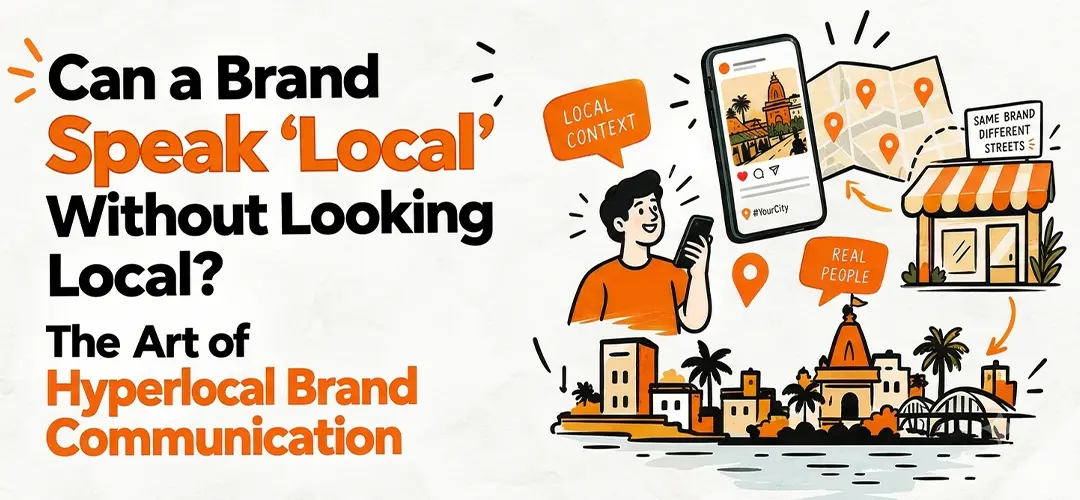
A brand can know the language. It can use regional celebrities. It can show familiar streets, festivals, food, and everyday situations. But does that automatically make the communication feel like it belongs there?
Not really.
People can usually tell when a brand is trying too hard to sound like them. A few regional words added to a national campaign don't make it relevant. Neither does putting a familiar landmark in the background.
The real challenge is understanding how people in a particular place live, think, speak, shop, and relate to brands.
That is where hyperlocal marketing comes in.
What Is Hyperlocal Marketing?
Hyperlocal marketing is a way to communicate with people based on their location and the behaviours, needs, culture, and context of that area.
It goes beyond saying, "This campaign is for Maharashtra" or "This one is for North India." It looks at smaller communities, towns, neighbourhoods, and markets and asks a more useful question:
Who are we speaking to, where are they, and what matters to them here?
A simple way to look at hyperlocal marketing is through three things:
- Place: Where does the audience live, shop, work, or spend time?
- People: What do they care about, how do they behave, and who influences their choices?
- Context: What local culture, language, occasion, need, or behaviour should shape the communication?
When these three come together, a campaign can feel less like a brand speaking at a market and more like a brand that actually understands it.
What matters to people here?
For example, a campaign for consumers in Mumbai may talk about local trains, compact homes, monsoons, or the pace of city life. The same product could be presented differently in a smaller Maharashtra town, where cultural references, purchase behaviour, media habits, and priorities may be different.
The point isn't to make every market look different for the sake of it. The point is to make the communication feel relevant.
Language Is Only One Part of the Picture
Language is often the first thing brands think about when going local. And yes, it matters.
But simply translating a national campaign into Marathi, Hindi, Bengali, Tamil, or another regional language doesn't necessarily make it feel natural.
Think about the difference between translating a sentence and understanding how someone would actually say it. A direct translation may be grammatically correct but still sound like an advertisement. Stronger communication reflects how people naturally speak.
That could mean using a familiar phrase, an expression, humour, a cultural reference, or simply a tone that feels less formal. Language is one part of the equation. Context is what makes it work.
The Same Product Can Mean Different Things In Different Places
A product doesn't always solve the same problem in every market.
Take something as simple as a two-wheeler.
In a metro city, it could be about avoiding traffic and making daily commutes easier. In a smaller town, it could also be connected to family mobility, business, education, or travelling longer distances.
The product hasn't changed. The context has.
This is where a strong local marketing strategy starts to matter. Before deciding what the communication should say, brands need to understand what the product means to people in that particular market.
Instead of asking, "How do we localise this campaign?", brands should ask:
"What would make this campaign feel like it belongs here?"
That small shift can change the entire creative approach.
India Makes More Interesting
India isn't one single market. A consumer in Bengaluru may discover a product through Instagram. Someone in a smaller town may hear about it through a retailer, WhatsApp, YouTube, or a recommendation from someone they know.
Even within the same state, media habits and purchase journeys can change considerably. So hyperlocal advertising India cannot simply mean creating a few regional versions of the same national campaign.
It needs a closer understanding of the people behind each market.
Semi-Urban Markets Need More Than a Rural-Urban Divide
The conversation around Indian consumers often gets divided into two broad groups: urban and rural. But there is a large and important space in between.
India's semi-urban markets have their own mix of aspirations, traditions, media habits, and purchasing behaviour. Consumers may be highly connected digitally while still relying on neighbourhood retailers, family opinions, and familiar networks when making a purchase. That makes semi-urban marketing particularly interesting.
A brand entering a semi-urban market cannot simply copy its urban communication and remove the city references. It needs to understand the retail environment, family influence, language preferences, aspirations, and how people discover and evaluate products.
The opportunity isn't to make the brand look "less urban". It is to make the brand feel more relevant.
Insight Should Come Before Execution
One common mistake brands make is starting with execution.
They decide they need a regional ad, a local influencer, or a vernacular social media page before understanding what they actually want to communicate.
A better approach is to start with insight.
- Who are we talking to?
- What are they familiar with?
- What do they care about?
- What influences their decisions?
- What do they already know about the category?
- What feels authentic to them?
Once those questions are answered, the execution becomes much easier.
Maybe the answer is a regional language film. Maybe it's a local creator. Maybe it's a retailer-led activation. It's likely a national campaign adapted with a culturally relevant insight. Hyperlocal marketing doesn't mean creating a completely different campaign for every location. It means knowing when a market needs a different conversation.
Technology Has Made Hyperlocal Advertising Easier
Digital media has changed how precisely brands can reach people. Brands can target communication based on geography, interests, behaviour, and other audience signals. This allows campaigns to be adapted for specific cities, towns, regions, or even smaller areas.
But better targeting doesn't automatically mean better communication. You can target the right pin code and still say the wrong thing.
That is why technology and creative thinking need to work together. Data can tell you where the audience is. Insight tells you what matters to them. Creative turns that understanding into something people want to notice.
Don't Overdo It
Ironically, trying too hard to look local can make a campaign feel less authentic.
Every sentence doesn't need a regional word. Every film doesn't need a festival. Every visual doesn't need a famous landmark.
When brands overuse cultural cues, the communication can start feeling like a checklist of "local things".
Good communication is often more subtle.
It could be a way of speaking.
- A familiar situation.
- A small behavioural detail.
- A market-specific need.
- A joke that only makes sense in that place.
Those details can make a campaign feel much more real than simply adding obvious cultural symbols.
The Role of an Advertising Agency
Building communication that works across different parts of India requires more than media targeting. An advertising agency in India needs to bring together consumer understanding, cultural context, creative thinking, media behaviour, and brand consistency. The challenge is to make the communication relevant to the market without losing what makes the brand recognisable. That balance matters. The brand should still sound like itself. The message should still be clear. But the way that message is expressed can change based on the people you're speaking to.
For example, a national brand could retain the same core promise across markets while changing the insight, language, characters, setting, creator, or media format.
The idea remains consistent. The expression becomes more relevant.
Hyperlocal Doesn't Mean Small
Some people think local communication is only useful for smaller markets or regional brands. That's changing.
Large brands are increasingly looking beyond broad national audiences and exploring more specific communities and markets. Coca-Cola's Share a Coke campaign in India is a good example. The global idea was adapted for Indian audiences with names and relationships such as "Bhai", "Didi" and "Papa", along with regional languages.
The same thinking can be seen in how Swiggy builds communication around local festivals, food habits and cultural moments, adapting its messaging to different regions instead of speaking to the whole country in the same way.
These examples show that hyperlocal communication doesn't always mean creating an entirely new campaign for every market. It can mean taking a larger brand idea and making it feel relevant to the people and culture of a particular place.
And with digital platforms, creators, location-based targeting, and regional content becoming easier to scale, brands can now experiment with local communication without building completely separate campaigns from scratch.
The opportunity is not simply to speak to more people. It is to speak more meaningfully to different people.
Conclusion
So, can a brand speak "local" without looking local? Yes.
In fact, the best local communication may not announce itself as local at all. It feels natural because it understands the audience rather than simply copying its surface-level culture. That is the real value of hyperlocal marketing. It helps brands move from saying something to everyone to saying something that feels relevant to someone. And in a country as diverse as India, that difference can matter a lot.
The future of local brand communication isn't about making every campaign look different. It's about making every audience feel understood. Because the strongest local idea doesn't say, "We know your culture."
It makes people feel, "They get us."
For brands looking to build stronger connections across diverse Indian markets, the right local marketing strategy can make that difference.