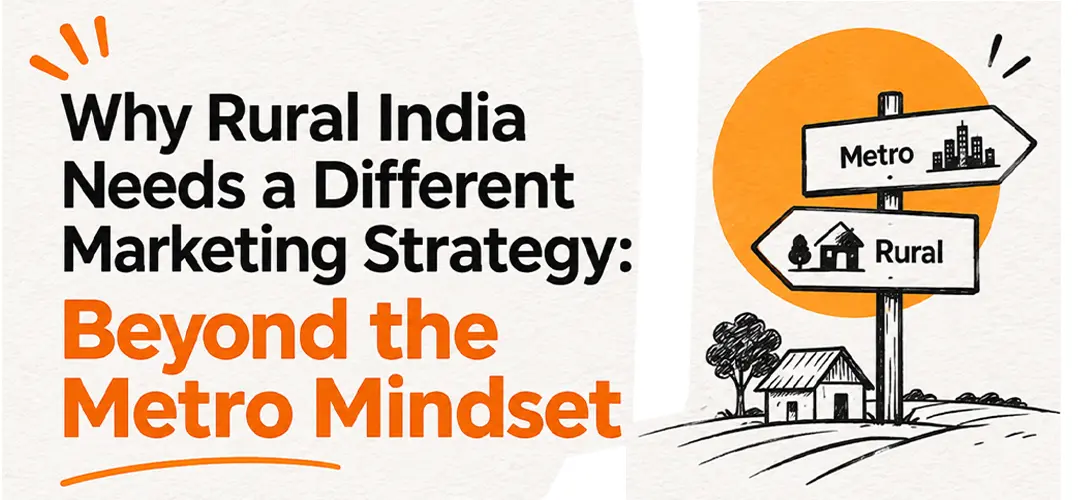
Why Rural India Needs a Different Marketing Approach
Take a brilliant metro campaign. Slick film, clever English line, a launch party in Mumbai. Now take it to a village in Bihar or a mandi town in Maharashtra. Chances are, it lands with a thud.
Not because the audience isn't interested. Because the campaign was never built for them.
India does not live only in its metros. A large share of the country's consumers sit in small towns and villages, with their own languages, habits, aspirations and ways of deciding what to buy. Rural marketing in India begins with accepting one simple fact: Bharat is not a smaller version of the city. It is a different market altogether.
In this guide, we cover what rural marketing is, why metro playbooks fail, how rural and urban consumers differ, five strategies that work, the role of digital, a planning framework, and the mistakes to avoid.
What Is Rural Marketing and Why Does It Matter in India?
So, what is rural marketing? In simple terms, it is the practice of planning products, services and communication for consumers in rural areas, along with the semi-urban towns that connect them to cities. It covers everything from agri inputs and FMCG to financial services, durables and health.
Rural marketing in India matters for three reasons:
• Scale. A big part of the country's population and consumption sits outside the metros. Ignoring it means ignoring a large part of your market.
• Rising aspiration. Better connectivity and wider access to mobile phones have raised expectations of what brands should offer.
• Open space. Many categories are crowded in the metros. In smaller markets, a brand that shows up with the right message can build trust early and keep it for years.
Rural India is no longer the "next big thing." It is already a big thing. Brands that treat it as an afterthought are leaving growth on the table.
Why Marketing Strategies That Work in Metro Cities May Not Work in Rural India
Metro playbooks quietly assume a few things: English-first communication, high digital comfort, a media diet of streaming and social feeds, and choices shaped by trends and reviews.
In a village or small town, the picture changes. Language is local. Decisions are shaped by family, neighbours and the local shopkeeper. Trust is earned slowly, through familiarity. Income often follows harvest cycles. And a campaign that talks down, talks over or simply talks in the wrong idiom is dismissed quickly.
A sound rural marketing strategy starts by letting go of the metro mindset. That does not mean dumbing things down. It means making things relevant. Rural consumers are sharp, value-conscious and well aware of what suits them. The job is to meet them where they are.
Understanding the Key Differences Between Rural and Urban Consumers
The differences go deeper than income or geography. Four stand out for any rural marketing strategy.
• Consumer needs and purchasing behaviour. Rural purchases are often driven by utility, durability and value for money. Decisions tend to be collective, with family and community input. Buying may be timed around harvests, festivals and weddings.
• Language and cultural preferences. Dialects, idioms, symbols and festivals vary from region to region. Brands need to adapt culturally, not just translate.
• Brand awareness and trust. Familiar names win. Trust builds through repeated presence, word of mouth and the recommendation of the local retailer.
• Media consumption and accessibility. The mix includes TV, radio, wall paintings, haats, fairs and fast-growing mobile use. Connectivity varies widely, so never assume one habit applies everywhere.
5 Effective Rural Advertising Strategies for Indian Brands
Here are five rural advertising strategies that work harder than a metro campaign with a Hindi voiceover.
Use Regional Languages and Culturally Relevant Messaging
Speak the way people speak. Use local language, idiom, humour and references. A line that sounds natural in Marathi may feel borrowed in Bhojpuri. Get the small details right, and people feel the brand was made for them.
Build Trust Through Local Communities and Influencers
In rural markets, trust travels through people. Local leaders, farmers, shopkeepers and regional creators carry more weight than a distant brand voice. Work with voices the community already listens to, and let them tell the story in their own way.
Use On-Ground Activations and Experiential Marketing
Seeing, touching and trying beats being told. Demos at mandis, haats and fairs, product sampling and community events let people experience the brand first-hand. They also give you a chance to listen, which is as valuable as being heard.
Combine Traditional Media With Digital Channels
Don't pick one over the other. TV, radio, print and outdoor still build reach and familiarity. Mobile and social channels add frequency and engagement. Used together, they reinforce each other.
Work With Local Retail and Trade Networks
The retailer is often the final influencer. Equip local shops with visibility, clear product information and simple incentives, so the brand is recommended at the moment of purchase.
How Rural Digital Marketing Is Changing Brand Communication
Rural digital marketing is growing as mobile phones and data reach more homes. It is not replacing traditional media. It is working alongside it, and changing how brands talk to people.
• Social media and mobile-first communication. Content now needs to work on a small screen, on a patchy connection, in a few seconds. Keep it light, visual and easy to share.
• Regional language digital content. People respond to content in their own language. Local-language video, audio and messaging open doors that English content cannot.
• Video marketing and local creators. Short videos and regional creators bring familiarity and credibility. A creator from the same region often connects faster than a national name.
• Digital campaigns that complement on-ground activities. A demo at a mandi can be followed by a regional video and a WhatsApp message. The physical moment creates trust, and the digital follow-up keeps the conversation going.
How to Build an Effective Rural Marketing Strategy
Identify the Right Rural Audience
Bharat is not one audience. Define the region, language, occupation and income pattern you are targeting. A cotton farmer in Vidarbha and a shopkeeper in a small UP town need different conversations.
Understand Local Needs and Consumer Behaviour
Go and listen. Talk to consumers and retailers. Use field visits, interviews and group discussions to learn what people really need, what they distrust and what makes them buy.
Adapt Brand Messaging to Regional Markets
Keep the brand idea consistent, but express it differently across regions. Adapt language, imagery, festivals and examples so the message feels local everywhere.
Select the Right Media and Communication Channels
Match channels to how your audience actually consumes media. Combine mass media, on-ground presence, local trade and digital, based on what works in each market.
Measure Campaign Reach and Effectiveness
Track reach, recall, engagement, trial and repeat purchase, not just immediate sales. Learn from each phase and refine the plan.
Common Rural Marketing Mistakes Brands Should Avoid
• Copy-pasting the metro campaign. Translation is not adaptation.
• Assuming rural means low-spending. Rural consumers are value-seekers, not value-compromisers.
• Ignoring regional differences. What works in one state may not work in the next district.
• Relying on a single channel. Reaching rural markets takes a mix of media and touchpoints.
• Talking down to the audience. Respect intelligence. Skip preachy messaging.
• Skipping on-ground research. Assumptions made in an office are rarely right.
• Measuring only short-term sales. Trust takes time. Track the build, not just the spike.
How Eggfirst Helps Brands Connect With Rural and Semi-Urban India
At Eggfirst, rural and semi-urban India is not a side project. It is the core of how we think. Over 22 years, our teams have travelled through villages, walked the mandis and spent time in regional markets across the country. We back that experience with proprietary research, including focus group discussions, in-depth interviews and CAPI interviews with consumers.
That groundwork shapes the communication we create. We culturally adapt campaigns for each region rather than simply translating them, so the brand sounds authentic wherever it shows up.
Our rural and semi-urban marketing services sit within a wider set of capabilities that include consumer and market research, ad film production, celebrity and influencer marketing, on-ground activation, media planning and digital marketing. Our portfolio also includes work for rural-facing and agri brands such as Chambal Fertilisers, Bayer, DeHaat and Siemens. And through Chalo Bharat, our annual conclave on Tier 2, Tier 3 and rural marketing, we keep learning where Bharat is heading.
Our tagline is "As good as our word." For brands, that means clear plans, firm timelines and communication that is built for the audience it is meant for.
Looking to connect with rural and semi-urban audiences? Explore Eggfirst's Rural & Semi-Urban Marketing Services.